Meme coin trading, how a $1,000,000 run was built and what it costs
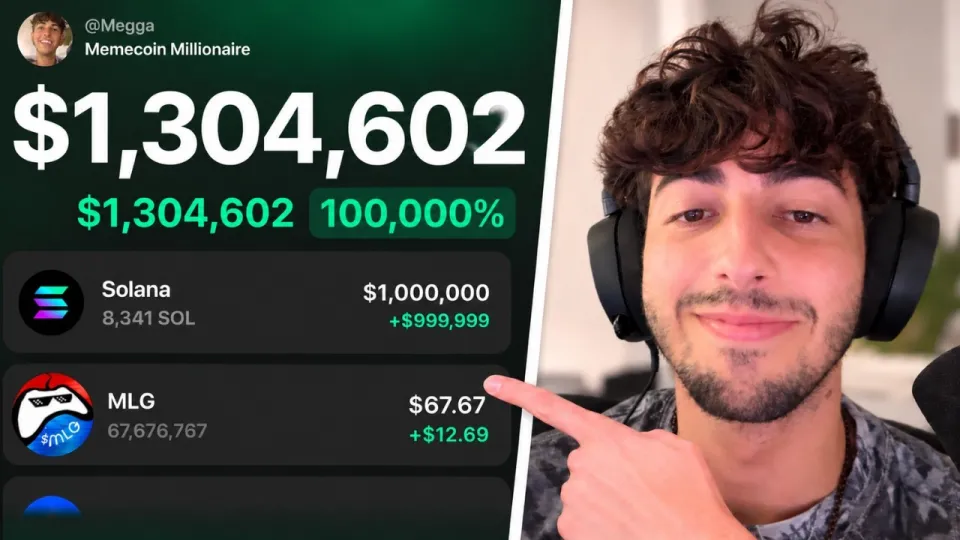
Video: How I Made $1,000,000 Trading Memecoins (FULL BREAKDOWN)
Need articles like this for your video? They help promote it on YouTube and Google — order them in the Telegram bot @sat_sit_bot. It writes articles around your video, embeds the video and publishes them on popular niche websites (no ads). Free trial — 50 articles.
· based on the channel Megga
Key takeaways
- Megga's breakdown covers a $1,000,000 result built on meme coins, not on a single lucky trade.
- The core of the method is repetition: screen, enter early, size positions, cut losses, repeat for months.
- Most of the time goes into research and monitoring, not clicking buy — the channel describes 9-to-12-hour sessions.
- Meme coin profits come from other participants' money, so liquidity, rugs and exit timing are the real risks.
- A free course and a low-fee trading platform are linked in the video description.
Meme coin trading is a high-risk, high-variance activity where a small number of early, well-sized entries can compound into a large result — and Megga's breakdown of a $1,000,000 run shows the process behind it rather than a single lucky ticket. The video walks through the routine that produced the number: screening new launches, entering early, sizing positions, cutting losses and repeating the cycle for months. The free course linked in the description — get the free meme coin trading course — is the entry point the author offers for anyone who wants to study the same framework.
What a meme coin actually is and why the returns look extreme
A meme coin is a token whose value rests on community attention and narrative rather than on cash flow, product revenue or collateral. That structure explains both sides of the story: because there is no earnings floor, price is set entirely by supply and demand, so a launch can multiply in hours and collapse just as fast. Liquidity is usually thin at the start, which means small buys move the price a lot — in both directions. There is no valuation anchor to fall back on, so the only thing that matters is whether someone else will pay more later. Every dollar of profit in this market is a dollar someone else put in, which is why the people who treat it as a game of timing and risk control tend to survive longer than the ones chasing a single 100x.
The method behind a $1,000,000 meme coin run
The reported seven-figure result is best read as the output of a repeatable process, not a jackpot. The structure that shows up again and again in serious meme coin trading looks like this:
- Screen constantly. Watch new launches, track which narratives are getting attention, and keep a shortlist of names worth a closer look.
- Enter early and small. Take a position while liquidity is still thin and the crowd has not arrived; the earliest entries carry the best risk-to-reward, and also the highest chance of total loss.
- Size by conviction, not by hope. A position that can wipe out the account on a rug is not a position, it is a bet on being lucky.
- Take profits in tranches. Selling part of a winner on the way up turns a paper gain into realized capital that funds the next attempt.
- Cut losers fast. In meme coins, a losing token rarely recovers; holding it is usually a decision to donate the remainder.
- Repeat for months. The million is the sum of many small decisions, most of which are routine and forgettable.
The channel is explicit that the hours are the real cost: the grind is described in terms of 9-to-12-hour sessions of monitoring charts, reading feeds and managing positions. That is the part viewers tend to skip when they see the final number.
How to trade meme coins without blowing up the bankroll
Risk management is the difference between a strategy and a lottery ticket. A few rules that make the difference in practice:
- Define a separate bankroll. Only money you can lose entirely belongs in this market; rent and savings do not.
- Cap single-position risk. Decide in advance what percentage of the bankroll one token can take, and keep it small enough that five losses in a row are survivable.
- Check the contract before buying. Look at holder concentration, whether the deployer can mint or freeze, and how much of the supply sits in a few wallets.
- Assume slippage and fees. Thin liquidity means your exit price is worse than the chart; factor that into the target.
- Write the exit before entering. A profit target and a stop level set in advance beat improvisation under pressure.
The uncomfortable side: rugs, liquidity and who pays for the gains
The meme coin market has a structural cost that does not appear in profit screenshots. When a token is abandoned or dumped by its creators, the people holding it lose their capital, and that capital is exactly what earlier sellers took out. Viewers of the breakdown raised this directly, questioning how much of the result came from being early versus from leaving others holding worthless tokens, and warning that newcomers copying the strategy may simply become exit liquidity. The honest framing is that this is a zero-sum arena at the token level: for every winner there is a loser, and the loser is often someone who entered later with less information. Understanding that is not a reason to avoid the topic, but it is a reason to treat position sizing, contract checks and exit discipline as non-negotiable rather than optional.
Common questions from traders in the trenches
Most of the doubts around this kind of content are practical rather than philosophical. Traders ask how much time the process really takes, whether a full-time job makes it impossible, how to tell a genuine narrative from a dead one, and how to recover after a drawdown. The answers tend to converge: the time requirement is real but can be compressed by focusing on fewer, better-screened names; a job means trading fewer setups with longer holding periods rather than more; narrative quality is judged by whether new capital keeps arriving after the first spike; and recovery starts with going back to the basics — smaller size, stricter rules, no revenge trades. Community matters too: even without friends trading alongside, streams, feeds and group chats provide the feedback loop that solo traders otherwise lack.
Useful links
- Free course: https://whop.com/checkout/plan_Jfp7BxTu8pWGu/?session=chs_HL1L0oQ9QcTEa3
- Trading platform with low fees: https://trade.padre.gg/rk/megga
- Twitch: http://www.twitch.tv/megga
- TikTok: https://www.tiktok.com/@meggafaze
- Twitter: https://twitter.com/megga
Bottom line
A $1,000,000 meme coin result is a story about repetition, position sizing and stamina far more than about one perfect call. The transferable part of the breakdown is the process: screen relentlessly, enter early with controlled size, take profits in pieces, cut losses without arguing, and accept that drawdowns are part of the path rather than proof that it does not work. The part that cannot be transferred is the outcome itself — variance in this market is brutal, and the same method can produce a very different number for someone else. Megga's full breakdown is worth watching for the routine behind the figure, and the free course is where the author points viewers who want to study the framework before risking capital.
Source: How I Made $1,000,000 Trading Memecoins (FULL BREAKDOWN) · Markdown version
Questions & answers
How much capital do you need to start trading meme coins?
There is no fixed minimum, but the bankroll rule matters more than the starting number: use only money you can lose entirely. Thin liquidity means small accounts can still take meaningful positions early, while large accounts face slippage on exit. Size each trade so that a series of losses does not end the account.
Can you trade meme coins with a full-time job?
Yes, but the approach has to change. Instead of monitoring launches all day, focus on fewer, better-screened names, use alerts, and accept longer holding periods with pre-set exits. The 9-to-12-hour grind described in the breakdown is a full-time commitment; part-time traders need stricter rules to compensate for less screen time.
How do you tell a real narrative from a dead one?
Watch whether new capital keeps arriving after the first price spike. A live narrative produces fresh buyers, growing holder counts and continued discussion; a dead one spikes once and bleeds as early buyers exit. Contract checks — holder concentration, mint and freeze permissions — filter out the most obvious traps before that point.
What should you do after a big drawdown?
Go back to basics: reduce position size, re-read your own rules, and stop trading for a short period if decisions are being driven by the need to recover. Losses are part of the process, but repeating them at the same size without changing anything is not. Rebuild with smaller risk until the process is consistent again.